Ad money down the drain: how the source list exposed junk traffic in Bing
Published July 31, 2026 · The site belongs to a customer and is anonymized here, but every number and screenshot is real, taken straight from Savri
During a routine check of a customer's traffic we spotted a pattern in the source list: 106 of the week's 776 visitors arrived through paid Bing clicks from so-called syndicated search partners, third-party sites allowed to show Bing ads. 96% of them left the site immediately without doing anything. The customer was paying for every seventh visitor and getting nothing back. The discovery took a few minutes, the fix is a setting in Microsoft Advertising, and 38 minutes after our email the issue was with the agency running the ads.
The discovery: four domains nobody recognizes
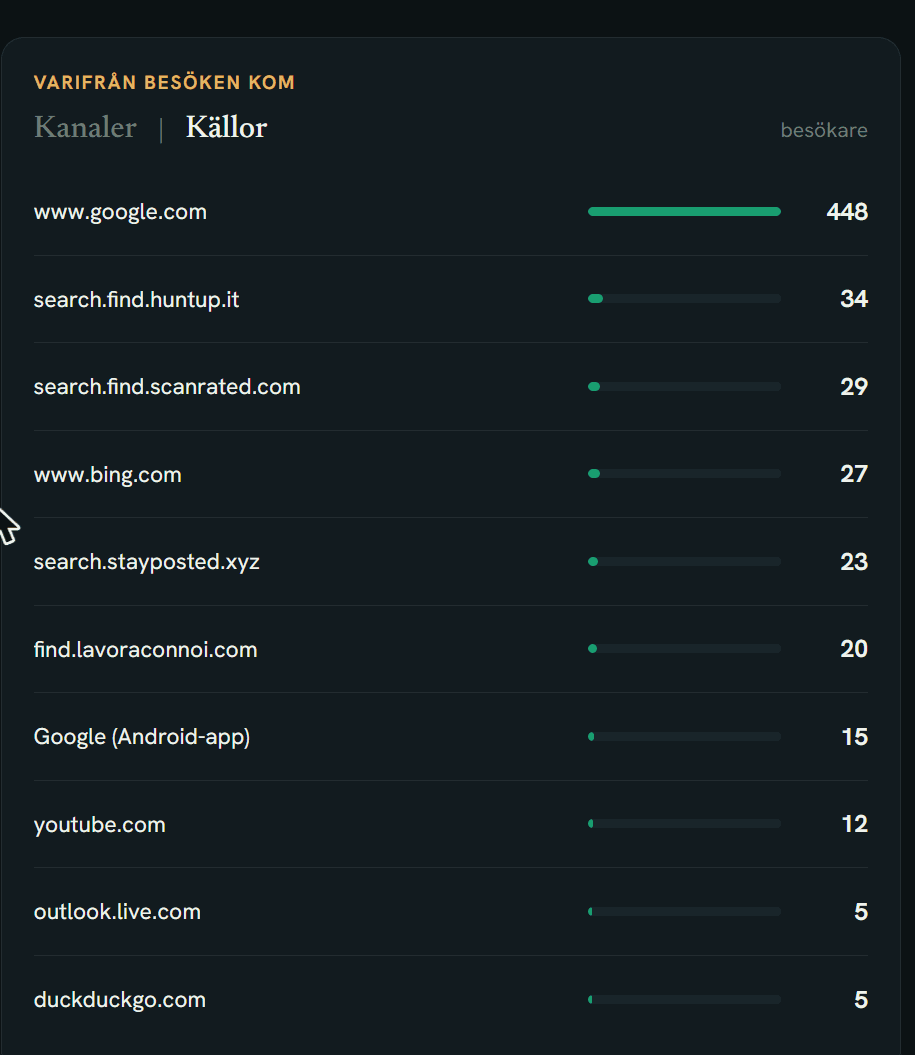
The site belongs to a Swedish specialist retailer whose traffic we keep an eye on. On the surface the week looked great: 776 visitors, up 25% and the site's best level yet. The traffic behaved the way humans do, with a clear nighttime dip, ordinary devices and Swedish cities. But in the source list, right below www.google.com, sat four domains we had never seen before.
- search.find.huntup.it34 visitors
- search.find.scanrated.com29 visitors
- search.stayposted.xyz23 visitors
- find.lavoraconnoi.com20 visitors
Together they account for 106 visitors in seven days. That is more than the site's real Bing traffic (27 visitors from www.bing.com) and almost one seventh of all visits that week. Every visit was tagged as paid Bing traffic, nearly all landed on the homepage, and 96% vanished without a single further click. Meanwhile, the site's regular Google traffic behaved completely normally.
What are syndicated search partners?
Microsoft doesn't only show Bing ads on bing.com. The ad network syndicates them out to partner sites, everything from legitimate search engines to search feeds embedded in adware and questionable browser extensions. The clicks often come from real people on real devices, but with zero purchase intent: the person wasn't looking for anything, a search box or ad feed was pushed in front of them.
This is a well-known phenomenon in paid search and nothing wrong with the campaigns themselves. The customer's campaigns were well built and the real Bing traffic behaved normally. But syndication is on by default, and in the ad account it doesn't show up as a problem, just as more clicks.
Why the bot filter doesn't catch this
Savri filters bot traffic in real time using datacenter IPs, spoofed user agents and known crawlers. That same week the filter stopped nine bot hits on the site. The junk clicks from search partners sailed straight through, and that is not a bug: the visits came from real Swedish phones with normal user agents. Technically, they are humans.

This class of traffic is only visible when you look at where visits come from and what they do next. The signature is referrer domains nobody recognizes, combined with near-100% bounce on a single landing page, while the rest of the traffic behaves normally. That is why the source list, not the bot filter, is the right tool for this check.
We also checked the rest of the network: of the 100+ sites we measure, this was the only one affected. No wave, just one campaign setting on one site.
The fix: one setting, 38 minutes
The solution requires no code. In Microsoft Advertising you can restrict ads to Microsoft's own search sites, or exclude specific partner domains. For whoever runs the campaigns it is a quick setting.
We emailed the customer at 17:36 with the screenshot above and the suggestion. By 18:12 the customer had forwarded it to their ad agency, and at 18:14 the agency replied that they were looking at it right away. From our email to the fix being on the right desk: 38 minutes.
"Nicely caught, thanks! Forwarded it right away."
The customer's reply, the same evening
What is a check like this worth?
We don't know exactly what the customer pays per Bing click, so we won't invent a number. What we do know is that every seventh visitor that week was paid traffic that could never turn into business, and that it would have quietly continued until someone looked at the source list.
The customer had also recently cut their ad budget substantially. The tighter the budget, the more every wasted click hurts, and the more ten minutes in the source list is worth.
That is the honest truth about analytics tools: the value isn't in the charts, it is in what you discover in them. A source list that shows where paid visits actually come from, together with how they behave afterwards, pays for itself the first time it finds something like this.
Run the same check on your own site
Running Bing ads, or paying an agency to run them? The check takes five minutes:
- 1
Open the source list in your analytics and look at the last 7 to 30 days.
- 2
Look for domains you don't recognize, often with patterns like search.find.* or find.* on odd top-level domains.
- 3
Compare behavior: near-100% bounce against a single landing page is the signature. Real search visits spread across the site and click onward.
- 4
If you find the pattern: ask whoever runs the campaigns to restrict serving to Microsoft's own search sites or exclude the domains, then follow up in the source list a week later.
See where your paid visits actually come from
Savri shows sources, channels and behavior for every visit, cookie-free and without a consent banner. The source list in this case study is the default view, not an add-on. Try it free for 30 days.